Rebuilding micrograd in C++, starting with one neuron
Intro
I’m picking up AI again, starting with this repo: karpathy/micrograd
Back in college, I studied AI as part of a course, but I didn’t put much time into it. Now that AI is literally changing the world, I want to understand it inside and out. This is my first real step.
My C++ version is here: junpark4395/micrograd.cpp
One thing I did differently. Karpathy builds the whole thing first (Value, Neuron, Layer, MLP) and then trains the MLP. I trained one neuron first. One weight, one bias, one input. It’s small enough to calculate every gradient by hand and check it against the code, number by number. Once that works, going to an MLP is just stacking more of the same thing.
The idea
The idea behind training is so clear and beautiful that it honestly shocked me.
- Run the inputs through the function (forward pass)
- Compare the result with the target
- Measure how far off it is (loss)
- Figure out how much each weight contributed to that error (gradient)
- Nudge each weight a little in the right direction
- Go back to 1
That’s all it does. My instant noodles have longer instructions.
I started with this very simple expression:
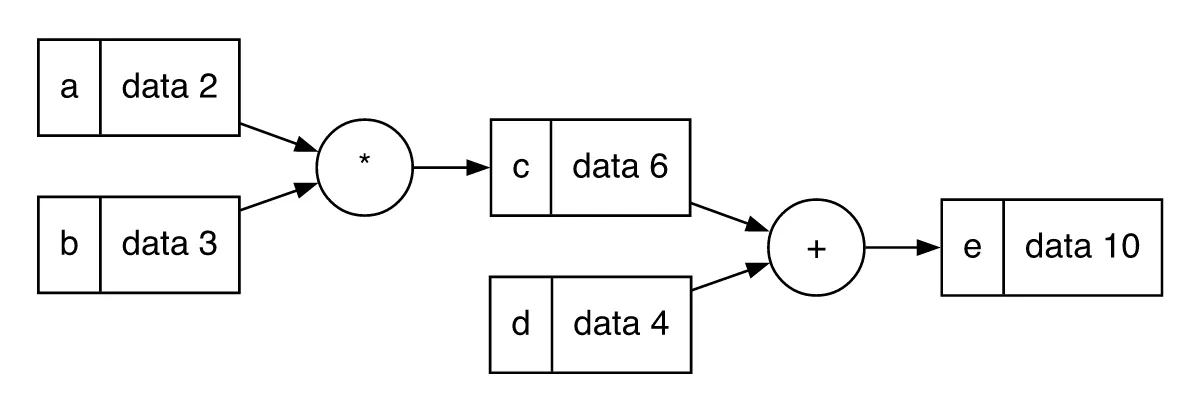
Then I added an activation function after e. Without one, no matter how many neurons we stack, the whole thing is still just one big linear function.
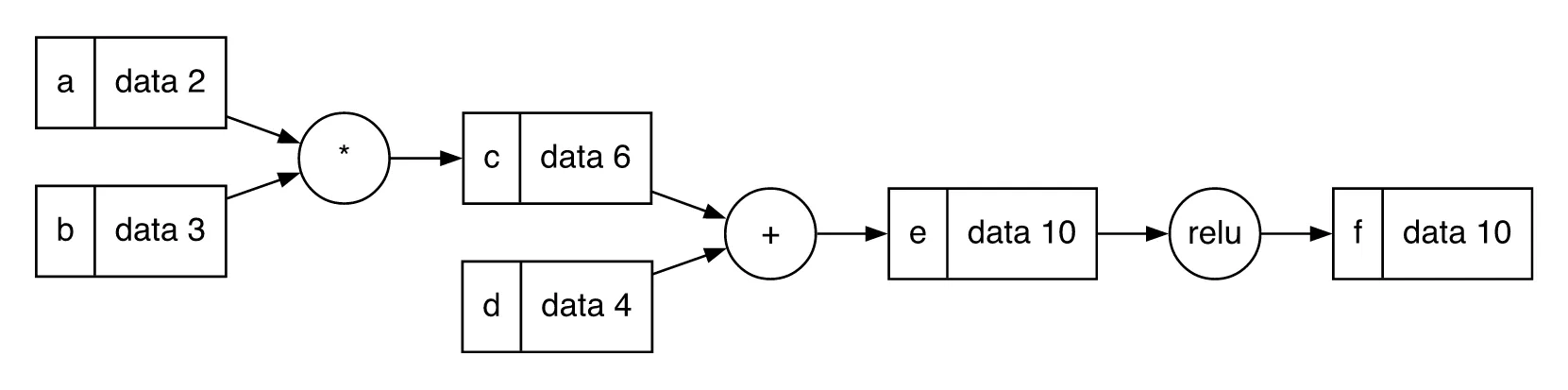
This is the neuron I just made:
class Value {public:    struct Node {        double value;        std::vector<std::shared_ptr<Node>> prev;
        Node(double v, std::vector<std::shared_ptr<Node>> children = {})            : value(v), prev(std::move(children)) {}    };
    std::shared_ptr<Node> node;
    Value(double _value, std::vector<std::shared_ptr<Node>> children = {})        : node(std::make_shared<Node>(_value, std::move(children))) {}
    Value operator+(const Value& other) const {        return Value(node->value + other.node->value, {node, other.node});    }
    Value operator*(const Value& other) const {        return Value(node->value * other.node->value, {node, other.node});    }
    Value relu() const {        return Value(std::max(0.0, node->value), {node});    }};
class Neuron {public:    std::vector<Value> w;    Value b{0};
    Neuron(int nin) {        std::mt19937 gen(std::random_device{}());        std::uniform_real_distribution<double> dist(-1.0, 1.0);
        for (int i = 0; i < nin; i++) {            w.push_back(Value(dist(gen)));        }
        b.node->value = dist(gen);    }
    Value forward(const std::vector<Value>& inputs) {        Value sum = b; // start from b instead of 0 to avoid an extra node        for (size_t i = 0; i < inputs.size(); i++) {            sum = sum + (w[i] * inputs[i]);        }
        return sum.relu();    }};
Value wraps a number and remembers which values it was made from. That’s where the graphs above come from.
Karpathy’s Value overloads a lot more operators, but I only implemented +, * and relu,
because that’s enough to run a basic case and understand how it works.
Neuron holds its weights as a vector of Values and initializes them with random numbers between -1 and 1.
int main() {    std::vector<Value> xs = {Value(2.0)};
    Neuron neuron(1);    Value output = neuron.forward(xs);
    std::println("output => {}", output.node->value); // std::println needs C++23
    return 0;}
output => 1.808225754493986The forward method multiplies each input by its weight, adds them up with the bias, and passes the result through relu.

OK, now what if I want to train it so the output becomes 1? What should I do?
All I can change are the weights and the bias, since the inputs are fixed. But before changing anything, I need to know how much each weight affects the output. That’s the gradient.
I think of it as turning a volume knob. Nudge it just a little and see how much the volume changes per step. That ratio is exactly what a gradient is.
It’s also easy to calculate. Especially with only one neuron.
Calculating the gradient
First, I need a single number that tells me how wrong the output is. This is called the loss. The simplest one is the squared error:
Squaring keeps it positive, and it grows the further we are from the target.
Here are the numbers from the graph above:
| value | |
|---|---|
| 2 | |
| 0.812472 | |
| 0.183282 | |
| target | 1 |
Forward pass:
Now I want and . In plain words: if I nudge (or ) a tiny bit, how much does change?
The chain rule
doesn’t depend on directly. It goes through a chain: . The chain rule says we can find how much each link changes the next one, and just multiply them together:
(Karpathy’s video explains this much better than I can. Here I’ll just do the math for my one neuron.)
Each link is easy on its own:
- Loss:
- relu: slope is 1 if , otherwise 0. , so it’s 1.
- : ,
Multiply them together:
Checking with the volume knob
Then I actually turned the knob. I nudged by 0.001 and ran the forward pass again:
Almost exactly the 3.232904 I got from the chain rule. The tiny difference is only because 0.001 isn’t infinitely small.
What the gradient tells us
Both gradients are positive. That means increasing or makes the loss bigger. So to bring the output down to 1, I should move both of them a little in the opposite direction. And since ’s gradient is twice as big, nudging moves the loss twice as much as nudging .
The pattern
Then I noticed something. Each node only needed its own small rule:
+passes the gradient to both inputs unchanged*sends each input the gradient times the other inputrelupasses the gradient through if its output was positive, otherwise sends 0
The gradient starts at the end and flows backwards through the graph, node by node. That’s backpropagation.
Next step: teach Value to do this by itself.
Backpropagation in code
Each node gets two new things:
grad: how much the final output changes when this node changes_backward: the node’s own small rule from the list above
struct Node { double value; double grad{0.0}; std::vector<std::shared_ptr<Node>> prev; std::function<void()> _backward;};Every operator creates a new node and attaches its rule to it:
Value operator+(const Value& other) const {    Value ret = Value(this->node->value + other.node->value, {this->node, other.node});
    ret.node->_backward = [ret_node = ret.node.get(), this_node = this->node, other_node = other.node]() {        this_node->grad += ret_node->grad;        other_node->grad += ret_node->grad;    };
    return ret;}
Value operator*(const Value& other) const {    Value ret = Value(this->node->value * other.node->value, {this->node, other.node});
    ret.node->_backward = [ret_node = ret.node.get(), this_node = this->node, other_node = other.node]() {        this_node->grad += other_node->value * ret_node->grad;        other_node->grad += this_node->value * ret_node->grad;    };
    return ret;}
Value relu() const {    Value ret = Value(std::max(0.0, this->node->value), {this->node});
    ret.node->_backward = [ret_node = ret.node.get(), this_node = this->node]() {        if (this_node->value > 0) {            this_node->grad += ret_node->grad;        }    };
    return ret;}
(That .get() on ret_node is a whole story. I’ll come back to it in the C++ part.)
operator-
To calculate the loss, I also need output - target, so I added operator-.
For :
So it’s the same as +, except the gradient going to the right side is flipped:
Value operator-(const Value& other) const {    Value ret = Value(this->node->value - other.node->value, {this->node, other.node});
    ret.node->_backward = [ret_node = ret.node.get(), this_node = this->node, other_node = other.node]() {        this_node->grad += ret_node->grad;        other_node->grad -= ret_node->grad;    };
    return ret;}
Why += and not =
Value diff = output - target;Value error = diff * diff;diff is used twice. It gets one gradient from each side of *, and both are real effects on the loss, so they have to be added up.
With =, the second one would overwrite the first:
That’s exactly from my hand calculation.
This is also why I have to reset every grad to 0 before each backward pass. Otherwise, they keep piling up from the previous round.
backward() and the topological sort
The last piece is calling every node’s _backward. But the order matters.
A node’s _backward passes its own grad to its inputs.
So before it runs, its grad has to be complete. Every node that uses it must have already sent its share.
When the order goes wrong
Take this tiny graph:
c = a + bd = c + aa reaches d in two ways: directly, and through c.
So should be 2.
Start with d.grad = 1 and run the rules in the right order:
druns:c.grad += 1,a.grad += 1cruns:a.grad += 1,b.grad += 1
a.grad = 2, b.grad = 1. Correct.
Now run c first:
cruns:c.gradis still 0, so it passes 0 toaandbdruns:c.grad += 1(too late,calready ran),a.grad += 1
a.grad = 1, b.grad = 0. Wrong.
The rule
Run a node’s
_backwardonly after every node that uses it has run.
A topological sort gives us exactly this. It lines up the nodes so that every node comes after all of its inputs. Reverse that list, and every node comes before its inputs.
void backward() {    std::vector<Node*> topo;    std::unordered_set<Node*> visited;
    auto build_topo = [&](auto& self, Node* n) -> void {        if (!n || visited.contains(n))            return;
        visited.insert(n);        for (const auto& child : n->prev) {            self(self, child.get());        }
        topo.push_back(n);    };
    build_topo(build_topo, this->node.get());
    this->node->grad = 1.0;    for (auto it = topo.rbegin(); it != topo.rend(); it++) {        if ((*it)->_backward) {            (*it)->_backward();        }    }}
It’s a depth-first search that pushes a node only after all of its inputs (prev) have been pushed.
visited makes sure each node is added only once. Otherwise a node with two users would run its _backward twice.
For the tiny graph above, we get topo = [a, b, c, d]. Reversed: d, c, b, a, the correct order.
The output’s own grad is set to 1 first, because changing the loss by 1 changes the loss by 1. Deep stuff.
(The auto& self thing is because a C++ lambda can’t call itself by name. So I pass it to itself. Feels illegal, but it compiles.)
Back to my neuron
Here’s what it looks like for my neuron and its loss, starting from error:
(I left relu out here. I’ll explain why in the training section.)
topo = [b, w, x, w*x, z, target, diff, error]reversed = [error, diff, target, z, w*x, x, w, b]diff is reached twice (diff * diff), but visited keeps it in the list once.
Walking the reversed list:
| step | node | what its _backward does |
result |
|---|---|---|---|
| 1 | error |
*: sends diff the other side × 1, twice |
diff.grad = 2 × 0.808226 = 1.616452 |
| 2 | diff |
-: passes to z, flipped to target |
z.grad = 1.616452, target.grad = −1.616452 |
| 3 | target |
leaf, nothing to do | |
| 4 | z |
+: passes to both inputs |
b.grad = (w*x).grad = 1.616452 |
| 5 | w*x |
*: sends each input the other side × 1.616452 |
w.grad = 3.232904, x.grad = 1.313322 |
| 6–8 | x, w, b |
leaves, nothing to do |
The same numbers as my hand calculation.
Training one neuron
Now I have everything I need:
- forward pass
- loss
- reset the grads, then
backward() - update
int main() {    std::vector<Value> xs = {Value(2.0)};    Value target(1.0);
    Neuron neuron(1, false); // nonlin = false, no relu on the output
    // same starting point as the hand calculation    neuron.w[0].node->value = 0.812472;    neuron.b.node->value = 0.183282;
    for (int epoch = 0; epoch < 50; epoch++) {        Value output = neuron.forward(xs);
        Value diff = output - target;        Value error = diff * diff;
        for (auto* p : neuron.parameters()) {            p->node->grad = 0.0;        }
        error.backward();
        for (auto* p : neuron.parameters()) {            std::println("Grad => {}", p->node->grad);        }
        for (auto* p : neuron.parameters()) {            p->node->value -= 0.02 * p->node->grad;        }
        std::println("Epoch {}: loss = {:.4f}", epoch, error.node->value);    }
    Value y_pred = neuron.forward(xs);    std::println("y_pred => {}, target => {}", y_pred.node->value, target.node->value);
    return 0;}
The update is value -= 0.02 * grad.
The minus is the “opposite direction” part: a positive gradient means “going up makes the loss worse”, so we go down.
0.02 is the learning rate, how big each step is. Too big, and we jump past the target. Too small, and it takes forever.
Only the parameters get their grads reset. x and target collect grads too, but nobody ever reads them, so they can pile up all they want.
Neuron now also has a parameters() method that returns its weights and bias, and a nonlin flag.
For a single output neuron I turned relu off (nonlin = false), the same as karpathy does for the last layer.
With relu, the output could never go below 0. And once it got stuck at 0, the gradient would stop flowing.
(z is positive here, so relu’s slope was 1 anyway. The hand calculation doesn’t change.)
Grad => 3.2329039999999996Grad => 1.6164519999999998Epoch 0: loss = 0.6532Grad => 2.5863232Grad => 1.2931616Epoch 1: loss = 0.4181Grad => 2.06905856Grad => 1.03452928Epoch 2: loss = 0.2676Epoch 3: loss = 0.1712Epoch 4: loss = 0.1096Epoch 5: loss = 0.0701...Epoch 10: loss = 0.0075...Epoch 20: loss = 0.0001...Epoch 49: loss = 0.0000y_pred => 1.0000115353869368, target => 1Epoch 0. The gradients are 3.232904 and 1.616452, exactly what I calculated by hand. And the loss goes down every epoch until the output is basically 1.
This is the moment I was waiting for. Pen and paper on one side, the program on the other, same numbers. With a whole MLP, I’d just have to trust it.
Extending to an MLP
Honestly, there isn’t much to say here. Once one neuron trains, the rest is just stacking:
Layer: a vector of neurons. Every neuron gets the same inputs, and the layer returns all of their outputs.MLP: a vector of layers. Each layer’s outputs become the next layer’s inputs.
// Layerstd::vector<Value> forward(const std::vector<Value>& inputs) {    std::vector<Value> out;    for (auto& itr : n) {        out.push_back(itr.forward(inputs));    }    return out;}
// MLPstd::vector<Value> forward(std::vector<Value> inputs) {    for (size_t i = 0; i < l.size(); i++) {        inputs = l[i].forward(inputs);    }    return inputs;}
That’s it. Vectors of vectors. I’m not going to pretend this part was hard.
MLP model(3, {4, 4, 1}) means 3 inputs, two hidden layers with 4 neurons each, and 1 output.
Hidden layers use relu. The last layer doesn’t, so the output can be negative.
Value doesn’t change at all. The graph just gets bigger, and backward() handles it the same way.
This is where the topological sort really matters: every hidden neuron’s output goes into all 4 neurons of the next layer, so almost every node has several users.
The training loop is almost the same as before. The only difference is that I now have 4 examples, so I add up their squared errors into one total_loss and call backward() on that.
I also changed the bias to start at 0. The full code is in the repo.
Epoch 0: loss = 7.5134Epoch 1: loss = 7.2841Epoch 2: loss = 1.8611Epoch 3: loss = 0.8682Epoch 4: loss = 0.5782...Epoch 9: loss = 0.1704...Epoch 19: loss = 0.0732...Epoch 29: loss = 0.0344...Epoch 39: loss = 0.0177...Epoch 49: loss = 0.0092y_pred => 1.0343216178873411, ys => 1y_pred => -1.0019122336702346, ys => -1y_pred => -1.001121397417316, ys => -1y_pred => 0.9137720345453981, ys => 1All four predictions end up close to their targets.
The weights are random, so every run is different. Some runs don’t get there in 50 epochs. That usually happens when some relu neurons start out outputting 0 for every input. Then their gradient is always 0, and they never learn. Running it again or training for more epochs usually fixes it.
The C++ part
Up to here, it’s basically karpathy’s micrograd with more semicolons. But Python was quietly doing a few things for me, and C++ made me do them myself.
Why shared_ptr at all
The reason is this line in Neuron::forward:
sum = sum + (w[i] * inputs[i]);w[i] * inputs[i] is a temporary. In C++, it dies at the semicolon.
But the graph still needs it later, during backward().
In Python, this just works. Everything is a reference, and an object lives as long as someone points to it. In C++, I had to build that myself.
So Value is just a handle, and the real data lives in a Node on the heap:
class Value {public: struct Node { /* value, grad, prev, _backward */ }; std::shared_ptr<Node> node;};Each node holds shared_ptrs to its inputs in prev. So as long as the final error is alive, the whole graph behind it stays alive.
And when error goes out of scope, everything gets freed in a chain.
Copying a Value copies the handle, not the node. That’s why Value sum = b; doesn’t create a new node,
and why p->node->value -= ... in the training loop updates the real weight that every graph points to.
The memory leak
That chain of freeing was supposed to happen. My first version captured ret.node itself in the lambda:
ret.node->_backward = [ret_node = ret.node, ...]() { ... };This looks fine, but it never frees anything.
The node owns _backward, and _backward owns a shared_ptr to the same node.
They keep each other alive forever, so the reference count never reaches 0.
Node ──owns──> _backward (lambda) ^ │ └─────owns────────┘Python’s garbage collector finds cycles like this and cleans them up, which is why karpathy’s version doesn’t have this problem.
C++’s shared_ptr only counts. It has no idea it’s in a circle.
Counting the ghosts
A leak like this doesn’t crash. Everything works, the loss goes down, life is good. Time to count the nodes:
struct Node {    static inline int alive = 0;
    Node(double v, std::vector<std::shared_ptr<Node>> children = {})        : value(v), prev(std::move(children)) { alive++; }    ~Node() { alive--; }    // ...};
After the single neuron training, with everything out of scope, Node::alive should be 0. It was 206.
And 206 adds up exactly:
- each epoch creates 4 new nodes (
w*x,z,diff,error), and all of them leak: 4 × 50 = 200 - the last
forwardfory_pred: 2 more - the leaked nodes hold on to the leaves (
w,b,x,target): 4 more
200 + 2 + 4 = 206.
206 nodes, living in my RAM rent-free. For the MLP it’s worse. 305 new nodes per epoch, so 15,591 leaked after 50 epochs and 305,341 after 1000.
Two ways to fix it
The lambda only needs to look at its own node. It doesn’t need to own it. So I break the cycle on that side.
1. weak_ptr
ret.node->_backward = [ret_node = std::weak_ptr<Node>(ret.node), ...]() { auto out = ret_node.lock(); this_node->grad += out->grad; // ...};This works. alive goes back to 0.
But every _backward call now does a lock(), which bumps the reference count up and down,
and in theory I should check if out is null, which can never happen.
2. Raw pointer
ret.node->_backward = [ret_node = ret.node.get(), ...]() { ... };This is safe because _backward belongs to that node. If the lambda is running, the node is still alive. There’s no way to call one without the other.
alive goes back to 0 here too.
I went with the raw pointer. Both work, but the raw pointer says what’s actually true: the node owns the lambda, not the other way around. A raw pointer in modern C++ looks scary, but here it just means “I’m looking, not owning.”
Only ret_node changes. this_node and other_node stay shared_ptr. They point to the inputs, not back to the node itself, so there’s no cycle there.
Wrap-up
That’s the whole idea of training a neural network: calculate, measure how wrong it is, find out who’s responsible, nudge them, repeat.
Start with one neuron. Check it by hand. Once the numbers match, the MLP is just more of the same.
Whether it’s one neuron or a whole MLP, it’s the same loop on the same Value.
Note to future me: in C++, count your nodes.